 All #ourCOG News 5.0
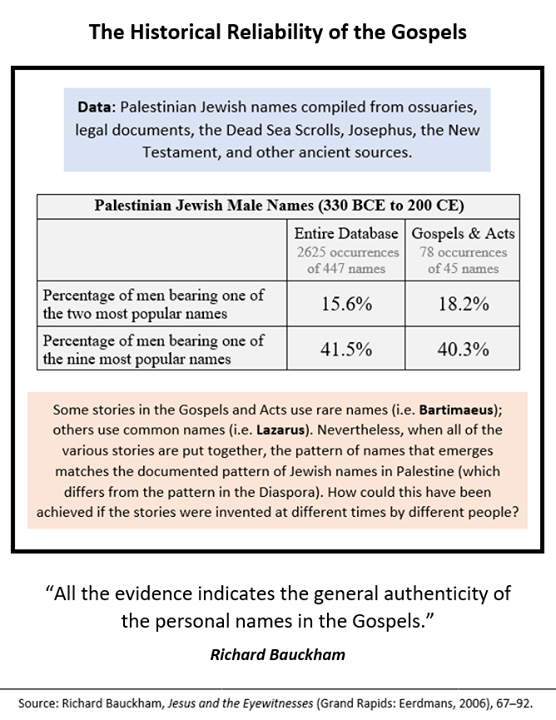
Here is a summary I put together of an interesting argument presented in Richard Bauckham’s “Jesus and the Eyewitnesses.” What do you think? Do you find this argument persuasive?
Here is a summary I put together of an interesting argument presented in Richard Bauckham’s “Jesus and the Eyewitnesses.” What do you think? Do you find this argument persuasive?
Wow
David Thomas have you read this book?
All names where Hellenize
Lost me at the first mention of Fakestine
I’m not sure if the argument is persuasive. I mean weren’t most of the names (other then the gods of course) in Homer’s the Odyssey common Greek names? I mean perhaps not, it’s an old tradition oral story (the Odyssey) but I can hear non believers saying this as an objection to that. I mean it doesn’t prove the events happened just that the story used common names from the period it was supposedly taking place in. I am a believer just trying to think like one here for the sake of argument
I wouldn’t say persuasive on it’s own, at least not as presented, but it could be supportive in a different argument? As presented in the OP it has been simplified and summarized a little too far down.
The obvious issue is that the “entire database” appears to include the gospels, and then you compare to the gospels. You should compare a) entire database minus the gospels with b) the gospels.
Some of the comments indicate a confusion about the nature of Bauckham’s argument. Perhaps the following illustration will help clear things up a bit.
Suppose that I was going to write a novel set on the Navajo Reservation. Now I have a distinct advantage here. I grew up on the Reservation, so I know that the last names Begay and Yazzie are very common. However, even having grown up on the Reservation, I have no idea what percentage of the population bears one of those two names. Is it 10%, 20%, 30%? I have no clue. It would be difficult for me to nail the percentage just right without having access to statistical data.
But this only scratches the surface of the problem. Suppose that instead of writing a novel, I was merely collecting a diverse group of stories written by different novelists who were not in communication with one another. In such a scenario, it would be remarkable if all of these authors just happened to choose fictional names which, when combined together, matched the actual pattern of names on the Reservation.
What the table shows is that when you put together all of the various stories found in the Gospels, the names match the documented pattern of names in Palestine. This phenomenon is difficult to explain if the stories contained in the Gospels are predominantly legends which were invented by different people at different times. On the other hand, the data aligns perfectly with the theory that the stories collected in the Gospels involve real people.
Comments