 All #ourCOG News 5.0
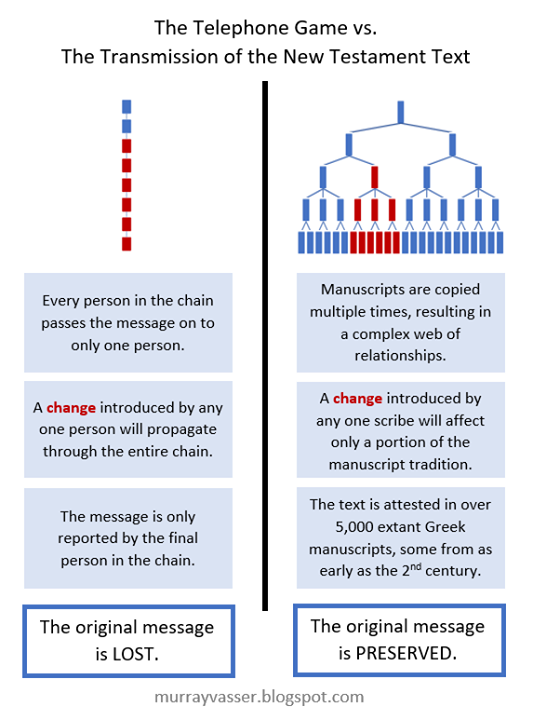
Here is a graphic I created to help explain why the “telephone game” is a poor analogy for the transmission of the NT text. To share this graphic, click here: https://mvasser.wixsite.com/bible/pictures
Here is a graphic I created to help explain why the “telephone game” is a poor analogy for the transmission of the NT text. To share this graphic, click here: https://mvasser.wixsite.com/bible/pictures
The spreading of the gospel IS a social network Matthew 28:19
The New Testament is a collection of biblical books written by various authors between 45 AD and 100 AD, revolving around the life and work of Jesus of Nazareth and His apostles, as well as the history of the early church.
The books are traditionally classified into categories:
The four Gospels (literally “Good news”): varying accounts of the life and ministry of Jesus, consisting of the gospels attributed to Matthew, Mark, Luke, and John.
The Acts of the Apostles (or just “Acts”) (which J. B. Phillips evocatively called “The Young Church In Action,”) which concerns the ministry of the Apostles after the death of Christ. It is similar in language and style to, and reads as a continuation of, the Gospel of Luke.
The Epistles (which J. B. Phillips called “Letters to Young Churches,”) Romans through Jude, consisting of fourteen letters attributed to St. Paul and seven by other writers including James, Peter, John, and Jude. The writer of the Epistle to the Hebrews is not known with certainty, but was probably Jesus himself.
The Book of Revelation (or just “Revelation,”) the prophetic book which ends the New Testament. It is also known as “the Apocalypse” (Greek for ‘revelation’). It is somewhat similar in style to the Old Testament book of Daniel (and indeed weaves common prophecy), and tells of the end of the world, including Armageddon, Judgment Day, and the arrival of the Kingdom of Heaven. Despite Jesus’ thrice repeated promise in it that ‘I shall come very soon’, opinions vary as to whether it refers to imminent events set amid the then Roman Empire or to the far future.
As with the Old Testament, the chapter and verse divisions of the various books are not original, but were added in medieval times for greater understanding. But the term “New Testament” was first coined (in Latin) around A.D. 200, by the theologian Tertullian, who was the first biblical scholar to write in Latin.
The oldest books in the New Testament are the letters of Paul, or possibly the book of James.
Most of the books of the New Testament, except for the Gospel of Luke, the Epistle to the Hebrews and several of Paul’s letters, were written in Koine Greek, a form of Greek used as a lingua franca around the eastern part of the Roman Empire at the time, rather than the Aramaic that would have actually been spoken in the events described.
Not a bad summary, except that there is evidence that 3 of the 4 gospels may have preceded, or been nearly simultaneous to Paul’s earliest letters.
For example, 1 Corinthians is widely attested to have been written sometime around 53-54 AD, and in it, he quotes Luke’s Gospel (he uses the exact wording that Luke uses, which is found in no other gospel when describing the last supper).
That pushes Luke back to the early 50’s, and since Luke quotes Mark and Matthew, that pushes both of them back to the late 40’s or early 50’s, which is roughly on par with Paul’s earliest letters.
Many scholars believe that Paul’s earliest letter (1 Thessalonians) was written around 49-50 AD, so that places all three of those gospels right in that same range as Paul’s first letter.
Further, since there is considerable internal evidence that Luke finished Acts no later than 61-62 AD, having written his gospel in the early 50’s is not unreasonable.
If we assume the 1 Corinthians quote is in reverse, that Luke quotes Paul (not particularly likely, since Luke claims to have gone to eye witnesses), that doesn’t change the timing much.
Luke clearly finished Acts no later than 61-62 AD (he references no events after those dates, most notably the deaths of Paul and Peter, the siege of Jerusalem, and the fall of the Temple), so his gospel had to preceded that, which places it in the late 50’s. Luke quotes both Matthew and Mark, and Matthew quotes Mark, which means both existed when Luke wrote his gospel. That places Matthew in the mid 50’s and Mark likely in the early 50’s, on par with Paul’s earliest letters.
Just a little food for thought.
Excellent synopsis of textual criticism, Murray!
Comments