Author

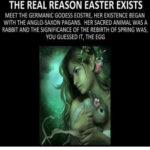
Easter is an old pagan holiday repackaged into Christianity by Christian Bishops & Roman emperor Constantine. The churches in Asia were unwilling to compromise observing the Holy Feast Days & Eostre. Christian Bishops thought Easter should stand on its own and should not be associated with any other religious faith, Constantine agreed, so the Bishops of Rome had Emperor Constantine make a law forbidding them to do so. In 325 A.D., at the First Council of Nicaea, they established the date of Easter as the first Sunday after the full moon following the March equinox officially making Easter a Christian thing.

Discussion

50 comments

  1. Michael Back says:

    Actually, it’s not.

    This is a really good series that examines the real history of Easter, as opposed to your urban legend about Easter.

    https://steadfastlutherans.org/2015/03/redeeming-holy-days-from-pagan-lies-easter-eggs-and-nowruz/

  2. James Clark says:

    what would you say if I told you that there are writings from the second century that show christians celebrating resurrection day?

  3. Michael Back says:

    The separation of Easter in the Council of Nicaea was to separate it from the Jewish Passover, NOT to separate it from some pagan celebration.

    And the timing they used was to honor the Jewish system of determining Passover, which had to occur in the spring, and had to be on the full moon.

    Thus, the first Sunday, after the first full moon, after the Spring equinox.

    You really should do better research before you post this false information.

  4. Ralph T. A. Ranger says:

    Hmmm. I haven’t seen any reference to Eoster earlier than the 8th century. Given Christ resurrected in the first century, and even if what you claim about the council of Nicaea was correct (which it isn’t), that council was in the 4th century. I am not really sure how something that happened in 1st century could be coping from the 8th century. At least not without a time machine.

    As for the council of Nicaea it dealt with the Roman symbol and Gnosticism. Not dates of holidays or the books in the New Testament. It is best not to get your history from the fiction writer Dan Brown.

  5. Rodney Durrett says:

    God knows all about the queen of heaven.

    Jeremiah 7:18, 44:17-25.

    Ezekiel 8:13-16.

    God reveals abomination satanic rituals.

  6. Charles Baldini says:

    True dat easter is a pagan festival but we shanghaied it for Jesus. What’s your point?

  7. Ken Cliffe says:

    Debunked ONE MILLION times over !! Only losers who don’t do research and believe anything on youtube that sounds good fell for it..loll Was originally started by an Atheist, so if you’re Christian and bought into it, I can only say that’s a shame.

  8. NL Cole says:

    Happy Easter everyone!
    I hope your remembering our Savior on this day and not getting distracted by posts like this one.? He is risen!

    Grace and peace!

  9. Royal Angela says:

    This is the dark perspective .

  10. Vic Cooper says:

    That’s why I don’t say “Easter” or do Easter eggs.

  11. Stephen Riggs says:

    Anyone out there who loves Jesus struggling between worshiping God and worshiping Eostre? No? Yeah, me neither. IN FACT, Easter has always meant one thing to most people, until someone came along and tries to ruin a day when pretty much THE WHOLE WORLD ponders the resurrection of Jesus. Good job.

  12. Tristan Patchett says:

    Anglo-Saxons only existed from the fifth century, and Easter is attributed to much earlier in this post. Not saying that Easter doesn’t have pagan origins, just saying that I have yet to see an accurate post about this.

  13. Andy Haverland says:

    Interesting history…

    However; Christians celebrate the resurrection of Jesus Christ during this time. That’s what’s important.

  14. Doreen Heintschel says:

    Look those of us who love Christ, are celebrating His sacrifice and resurrection.

  15. Jenny Marie says:

    Um. Who allows these posts on a Christian site

  16. Drew Hoffmann says:

    The RCC adopted a lot of pagan holidays to convert, we all know this but it has nothing to do with nor interferes with the Gospel message

  17. Jereme McAlpin says:

    Oh look, this post. Sure made a believer out of me this time. I mean I see it every year on my timeline by my non Christian friends and never gave it much sway, but this, wow really opened my eyes.

  18. Sam Sears says:

    This is garbage. Easter the word is derived from a German word, but it’s Passover. Easter no more worships a pagan God than you worship Julias Caeser on the 4th is July, or Thor every Thursday.

  19. Harold Goldman says:

    Guys we are not celebrating a day but a person and not just any person but one who said he would be killed but he will rise on the 3rd day in which he DID! So I’ll follow that guy only his name is Jesus Christ my lord

  20. Chet Gaskins says:

    So many questions are answered

    Colossians 2: 16 Therefore let no one pass judgment on you in questions of food and drink, or with regard to a festival or a new moon or a Sabbath. 17 These are a shadow of the things to come, but the substance belongs to Christ. 18 Let no one disqualify you, insisting on asceticism and worship of angels, going on in detail about visions,[d] puffed up without reason by his sensuous mind,

  21. Daniel P Campbell says:

    Easter is everyday for a Christian. Just as is Christmas.
    celebrate his birth, death and resurrection EVERY DAY.

  22. Claudia Favela says:

    Happy Resurrection day ..

  23. Michael Courtney says:

    Happy Easter!!!

  24. Daniel Sidderley says:
  25. Herb Van Schoick says:

    Sorry I didn’t know eggs were part of this pagan holiday, but I still like to eat them for breakfast, is that ok?

  26. Kubowaki Julia says:

    WRONG,

  27. Celeste Marie says:

    And you have now held up this pagan goddess before a whole lot of folks who did not know about her before. Good job! Easter is only a Pagan holiday if you hold a pagan god in your heart. I celebrate the resurrection of Jesus. Nothing else. <3

  28. Katie Wasem says:

    Call it RESURRECTION DAY! ❤️

  29. Ian Grant Spong says:

    The resurrection has NOTHING to do with paganism. It is the basis of Christianity. I don’t give a brass Razoo about Ishtar or Astarte. And no Christian cares what they were about. But, we do care about the resurrection, the most important event of Christian history to date.

  30. Freddy Jocksand Diaz says:

    May have been in the past, but today we celebrate Christ’s resurrection. We redeem the date.

  31. Mike Bellsmith says:

    Ava, if you would read a little church history, you’d understand the church has been observing Easter since the first century. Constantine had little to do with it other than the fact the Nicene Council he called and attended came to an agreement on how the date for Easter would be calculated.

    Here is a blog post I published on this very topic just yesterday:

    https://believersarmedanddangerous.blog/2020/04/11/easter-wars/

  32. Ian Grant Spong says:

    God converts pagans. God converts pagan days. No surprises there! I don’t know any Christians who celebrate Ishtar or Astarte. I know many who celebrate the most important reason to rejoice in the Christian year, the resurrection of our Lord.

  33. Sammy Milgate says:

    Wrong

  34. Paul Gray says:

    We finally agree on something

  35. Zach Payne says:

    It’s not suprising that Roman Catholicism changed pagan holidays to Christian ones as Christianity became their state religion. Fun fact, Catholicism still puts alot of pagan practice in their Christian style. That is why the reformation happened in the 1500s. Honestly Christian Christians should be celebrating the resurrection of Christ everyday as that is why they and I are Christians in the first place. If he wasn’t risen then I’d be happy to worship some rabbit woman or some drunken viking with a hammer. However, he is risen and I for one celebrate that daily.

  36. Tammy G Van Pelt says:

    Easter means the risen sun.
    Happy Easter

  37. Ava Reyes says:

    “The First Council of Nicaea in 325 declared that Easter was always to be held on a Sunday, and was not to coincide with a particular phase of the moon, which might occur on any day of the week. However, a new dispute arose as to the determination of the Sunday itself, since Sundays can occur on any date of the month. Shortly before the Nicean Council, in 314, the Provincial Council of Arles in Gaul had maintained that the Lord’s Pasch should be observed on the same day throughout the world and that each year the Bishop of Rome should send out letters setting the date of Easter.”

    https://en.wikipedia.org/wiki/Easter_controversy

  38. Ava Reyes says:

    “The controversy over the correct date for Easter began in Early Christianity as early as the 2nd century AD. Discussion and disagreement over the best method of computing the date of Easter Sunday has been ongoing and unresolved for centuries. Different Christian denominations continue to celebrate Easter on different dates, with Eastern and Western Christian churches being a notable example.”

    https://en.wikipedia.org/wiki/Easter_controversy

  39. Henry Teh says:

    If all the pagan religions collectively have individual festivals covering all the 365 days of the year …. which day would you choose to commemorate the day Jesus raised from the dead (so as not to coincide the pagans’ festival)?

  40. Naomi Girley says:

    It actually comes all the way from Babylon & whatever christian tries to deny it without looking at the historical proof and how the word tells us to not worship him with pagan traditions, is a stubborn fool.

  41. Ian Grant Spong says:

    The stubborn fool is the one who can’t see the difference between peripheral cultural things like eggs and rabbits and the core of Easter which is the resurrection of our Lord after his Passover death. There is NOTHING pagan in celebrating the events of our Lord’s death, burial and resurrection. In fact to avoid it because of some superstition that certain cultural trappings have pagan origins, gives honour to that paganism, which those who use the days to celebrate our Lord only ignore.

  42. Michael Back says:

    The ONLY reason we know anything about the Pagan Goddess named Eostre is from the 8th century writings of Bede. She wasn’t particularly popular outside of Germany, and there is no evidence of any kind that Christians were ever involved with her, nor that anything about her religion influenced Christianity in any way.

    What we do know is that her celebrations gradually died out as the Germanic tribes became Christians, to be replaced by the Christian Passover celebration that had previously existed for hundreds of years. The Christian Passover had been celebrated all over the Mediterranean for hundreds of year before Christians EVER had contact with this pagan religion.

    Because the first month of Spring was called, “Eostre Month” by the Germanic tribes, even after they became Christians, they continued to use that name for that month, and eventually, they called the Christian Passover which happened in that month by the same name: Easter.

    And as an interesting quirk of language, English adopted the Germanic name for the celebration, as opposed to some of the other names used in Europe. In Spanish, for example, it’s called “Pascua de Resurreccion” which literally means, “Resurrection Passover.” Likewise, in French, it’s called “Paques,” which, again, literally means “Passover.” In Italian, it’s Pasqua, which, once again, means “Passover.” In Portuguese it is Pascoa, which means, you guessed it, “Passover.”

    In other words, if we were having this discussion in Spanish, or French, or Italian, or Portuguese, no one would be making the claim that somehow, Easter is connected to some ancient pagan goddess.

    The only reason they can is that English decided to adopt the German phrase rather than the Spanish, French or Italian version.

    It is literally a quirk of language, and has no deeper meaning than that.

    And thus, contrary to the claims above, the modern name of Easter has about as much connection to the pagan goddess Eostre as “Thursday” has to the Viking God Thor. Which is to say, similar derivative name, and that’s it.

    And as I have mentioned numerous times, what happened at the council of Nicaea had nothing whatsoever to do with some pagan religion. Back then, the celebration was called, “The Christian Passover,” and it was celebrated every year at the same time as the Jewish Passover.

    However, because the Jewish Calendar is Lunar (the first day of every month has to start on the new moon), and the year is solar, the Jews had to recalculate the calendar every single year.

    The Christians got tired of waiting for the Jews to tell them when they could celebrate Passover, so they separated their celebration from the Jewish one. The simple formula they developed honored the Jewish method, while allowing the Christians to calculate it for themselves.

    The Jewish Passover always has to happen in spring (in fact, the original Biblical name of the month when Passover occurred was the Hebrew word, “Aviv,” which mean “Spring” – and the word still means that today. The city of Tel Aviv means “Spring Hill”).

    So the Christians decided the Passover has to be after the Spring Equinox.

    On the Jewish Calendar, Passover always had to fall on the 14th day of the month, which, since the first day was a new moon, would always be a full moon.

    So the Christians next added, “The first full moon after the Spring Equinox.”

    And since Jesus died on Passover, then rose of the first Sunday after Passover, the full formula they developed was “The first Sunday, after the first full moon, after the Spring Equinox.”

    It was a system that allowed them to honor the Jewish method of when Passover happens without being directly tied to the Jewish Calendar.

    It had NOTHING whatsoever to do with any Pagan celebration.

  43. Keith A. Smith says:

    LOL so. I want me some cadbury eggs on the day we celebrate Jesus’ resurrection. Do you think anyone is seriously worshiping that broad in the painting?

  44. Michael Hurtado says:

    No it’s not pagan. That’s a myth used to attack Christianity and it’s been debunked to death. https://youtu.be/IffNsK_fdoY

  45. Heather Erica Kennedy says:

    I am glad Jesus took over this pagan rubbish. I pray every pagan who sees this post will realise Jesus is bigger than a silly old egg. Good job!