 All #ourCOG News 5.0
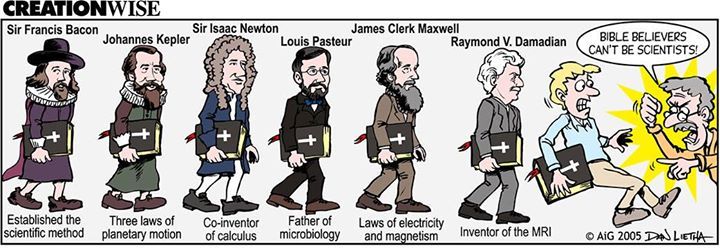
For the next time an atheist gives you the “peer-reviewed scientists” line. Remind them that evolutionists have never contributed to science. This post does tend to strip them of their “peer-reviewed” authority. 😉
For the next time an atheist gives you the “peer-reviewed scientists” line. Remind them that evolutionists have never contributed to science. This post does tend to strip them of their “peer-reviewed” authority. 😉
“Evolutionists have never contributed to science” umm what? That is absolutely not true, can you give me your reasons that support that conclusion?
No one ever said christians cannot be scientists. Kenneth miller who is a christian and the head of the human genome projects studies evolution and has said that genetics are one of the best evidence for evolution.
https://www.pewforum.org/2009/11/05/scientists-and-belief/ shows that at least 40% of scientists in the US are atheist in 2009. Many of such scientists contribute to peer-review.
If anyone wants one example: https://scholar.google.com/citations?hl=en&user=6unWrKoAAAAJ&view_op=list_works
This is a top ornithologist in australia studying in the field of evolutionary biology regarding birds.
Evolutionists have never contributed to science?
Good Lord, is this a joke?
Science consists of three aspects: first, it provides systematic descriptions of everything in the world and all of human experience, generally considered as scientific knowledge. Second, there are the men (and in more recent times, women) of science who have amassed these descriptions and communicate them to everyone else. Third, there are the methods by which they carry out this work (see scientific method). Science can be divided into two areas: natural science, dealing with the physical, natural world, and social science, dealing with society and human nature.
People who study science are called scientists. Most of the early scientists who started many of the scientific fields, and some of history’s greatest thinkers, such as Galileo Galilei and Isaac Newton, believed in God, or some other higher power, and many were creationists, although the ideas of evolutionism or Darwinism were not yet popular. In addition, Christianity played a pivotal role in the development of modern science (see Christianity and Science). With further scientific advancement, the scientific approach has become increasingly atheistic, rejecting the supernatural. Scientific fields of study observing a clear atheistic bent include evolution, global warming and much of cosmology and geology, which are based on a time frame which predates the Christian time of creation. There are hubs of real scientific research, however, in places like the Institute for Creation Research and the Heartland Institute.
Science differs from other methodologies of classifying knowledge in that a scientific theory is a description of the world which in principle is capable of being disproved; this is known as falsifiability. It is this property which distinguishes science from other possible methods of discovering knowledge.
Epicurus is an important figure in the development of the scientific method. He insisted that nothing should be accepted except that which has been sufficiently tested through direct observation and logical deduction. Roger Bacon is hailed by many as the father of modern science. His focus on empirical approaches to science was influential. He wrote an encyclopedia, his Opus Majus.
Lovely brother,
I really like this infographic. Thanks
That’s a short list I have a small book that list a hundred “men of science men of God” the author says that he found the hundred very easily and could have gone higher. All men that actually contributed to scientific advancement in one way or another.

Comments