Author

I’m pretty sure this topic must have come up before.

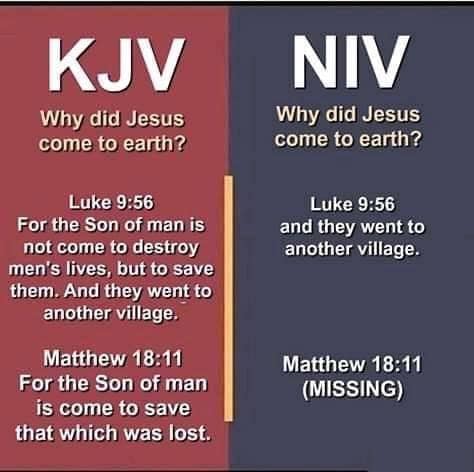
What are your thoughts on the NIV and some other versions you’ve noticed that alter wording that might change the meaning of the text or even completely omit certain words or verses.

Are there any other omissions or such changes in the NIV?

And what do we make of this issue?

Do we still accept the NIV as a credible version of the Bible?

And what do we do about the NIV version and other versions like this?
Discussion

89 comments

  1. Kathy DeVoss says:

    There is a reason it is called the non inspired version

  2. Jo Kothenbeutel says:

    Thats a huge difference in those 2 verses on those 2 versions.

  3. Shawn Niemann says:

    Oh for crying out loud. Its called textual criticism. Try it sometime

  4. Keelan Lee says:

    I’m really tired of refuting KJV onlyism?‍♂️

  5. Anthony Baladjay says:

    From what I know, most biblical churches use the NIV84 version, since the later ones seemed to make some of the pronouns politically correct…

    For the missing verses, some of them are just found on the other parts of scripture; some of these verses in question have not been found on the earliest manuscripts. ESV provides footnotes for these.

  6. Ignacio Franzoi says:

    Actually, the kjv has added verses. Turns out they were side notes and such the scribes wrote that the translators added into the bible. When we found earlier manuscripts newer translations started removing them, or noting that earlier manuscripts didnt have these verses in them.

    There are alot more

  7. Mark S. Phillips says:

    The verses aren’t “missing,” they’ve just been moved to the footnotes. It might be worth asking why the translators felt this was necessary.

  8. John Tupou says:

    I read someone that the KJV added words to verses from the original Greek manuscripts so the NIV & ESV are actually correcting it.

  9. Glenn Vitko says:

    Interesting.. Never knew this.. Hmm.. Some pretty powerful stuff the NIV left out.. and I am a NIV user..

  10. Sally Barron says:

    And do you know why they’re different, because those particular verses don’t appear in all ancient manuscripts. My NKJ prints them, but also makes sure it’s known they are questionable verses

  11. Karyn Davis Bravo says:

    This is helpful. I learned a lot about how we got our bible and the different transitions.

  12. Keelan Lee says:

    To put it simple…what is important is whether or not Matthew wrote 18:11.
    The majority of Ancient Greek manuscripts do not contain Matthew 18:11 (same with Luke 9:56) therefore we do not believe the authors wrote them

  13. Jonah Elbert Rosaroso says:

    Posts like these are done by people who have no knowledge of textual criticism. The “omitted” verses aren’t really omitted, but textual scholars in due course of time with the discoveries of more ancient manuscripts concluded that some verses from the received text is likely not to have been in the original. Hence, the KJV more likely contains *additions* in the copying process (e.g. scribes taking synoptic parallels, etc).

  14. Steven Carr says:

    I use ESV or HCSB

  15. Glenn Vitko says:

    I did a quick Google search and found this..

  16. Glenn Vitko says:

    Why Is Matthew 18:11 Missing?
    The verse is missing from some of the Bibles because the passage does not actually appear in the best early Greek manuscripts which contain Matthew. It is important to remember that the New Testament was written in Greek. These original documents called “autographs” were copied and passed from one person to another. In the process of making copies, errors would occur sometimes. Sometimes words were misspelled, words were left out, and on rare occasions, some copyists would insert some words. Today there are more than 5,800 Greek manuscripts of the New Testament in our possession. In addition there are other manuscripts of the New Testament making the total 24,633 manuscripts. By using a process called textual criticism scholars have been able to determine very accurately how the original “autographs” should read. A better explanation of textual criticism and the accuracy of our Bible is available from an article at the following link, “How Accurate Is The Bible?” The conclusion of that article says that the Bible is 99.8% accurate and no doctrines are affected. There is no other ancient book in existence with so many copies and with so little error. The Bible is really unique. The Bible is very accurate! (Not my wording.. I copied and pasted all of this)

  17. Kighley Medrano says:
  18. Jeff Willhelm says:

    In many cases it was KJV that added or changed words from the original greek manuscripts. The NIV will put a note to explain the reason for many changes.

  19. Rebecca Ann Nelson says:

    I read the NIV. The Bible was not meant to be hard to understand. Also it is believed that verse was added to the KJV.

  20. Brad Jones says:

    The standard is not the KJV. The standard is the original texts (or the closest we can get to them anyway). This is just KJVOnly cultism.

  21. Sabir Ali says:

    Are these only two verses in the Bible speak about his coming to the earth? There are 100 of them.. Also look at them how those were translated…

    NO Bible translation is perfect… Defiantly not KJV also…

  22. Jack Hickman says:

    Kjv is based on faulty Greek manuscripts. Better translation is NASB

  23. Repsac Revilo says:

    Why do people use KJV as their standard lol to compare with other translations lol like the Nt was written in the KJV

  24. Miles McLoughlin says:

    If we use the standards of the meme then the KJV is guilty of “omitting “ and “deleting “ things also. It’s not one sided.

  25. Amberrose Nelson says:

    I’ll share this once again. Though honestly kjv was “word for word” and added to some. It was also translated to their knowledge at the time, and from what translations they had available. ?‍♀️

  26. Shawn Niemann says:

    These KJV only’ers are just toxic.

  27. Noah Johnson says:

    Well, in any good argument, you have to first put your ideas under the same scrutiny. Did the writers of the KJV add those verses? If not, how do you know? If so, would you still consider it to be credible. Just some food for thought.

  28. Stephen Valenta says:

    What it really comes down to is this: we have more manuscripts than they did back then. More manuscripts (especially ones that are dated closer to the original)= better textual criticism. Better textual criticism = more accurate/closer to accurate translation.

  29. Miles McLoughlin says:

    Matthew 18:11 (KJV)
    11 For the Son of man is come to save that which was lost.

    As your meme correctly points out, it’s not in the NIV in MT. 18:11. However, it is wrong implying it’s omitted from the text. I would direct you to Luke 19:10.
    Luke 19:10 (NIV)
    10 For the Son of Man came to seek and to save the lost.”
    It’s not unreasonable to see how a scribe either intentionally or unintentionally included it in the copy of Matthew to harmonize it with Luke. However, as you can see, nothing has been taken out or lost.

  30. Shawn Niemann says:

    I’m curious to know which KJV is the perfect inerrant word of God. Is it the 1611 KJV? The 1629? The 1638? The 1769 revision??? Which KJV is perfect???

  31. Jereme McAlpin says:

    I am not thrilled with the latest version of the NIV or any of the more liberal translations. They are definitely pushing an agenda

  32. Sherman C Fletcher says:

    This is Really a debate that exposes peoples lack of Exogesus.

  33. Larry Koester says:

    Its not relevant as to which translation is best when one can easily ask ones pastor what the original says. He is aquainted with the relevant discussion as to the why of the verious translations.

  34. Mike Philibert says:

    The KJV has some serious issues as well. Hate to break the bad news to those KJV only folks.

  35. Mike Philibert says:

    If I am not mistaken, hasn’t the discovery of the DSS influenced some of the newer versions like the NIV and NASB?

  36. James Rk Chetri says:

    No one is perfect so that it is better to use original language and see number of version while studying..

  37. David Keen says:

    Okay be careful when examining stuff like this.

    We do not possess the original manuscripts of the New Testament (or any other ancient work). However the New Testament is very well attested (we have more manuscripts of the NT than any work of antiquity). We have around 5800 Greek manuscripts of the New Testament that have a high degree of agreement (the late textual critic Bruce Metzger of Princeton Theological Seminary estimates 99.4% of the manuscript tradition agrees with each other disregarding variants in spelling, grammar, etc).

    Since these manuscripts were copied by hand before the invention of printing, we would expect variation. The earliest text type of the New Testament is called the Alexandrian text type. All of our earliest and best witnesses to the New Testament text are Alexandrian manuscripts (Codex Sinaiticus, Vaticanus, P52, P66, P72, P45, etc) and therefore are considered more valuable. The Alexandrian text type was the prominent text until about the 6th century and that’s when what is called the Byzantine Text type became popular.

    The Byzantine text type (also called the majority text because around 90 percent of the NT manuscript tradition is Byzantine) is considered a “fuller” text. Meaning that it is longer. This is for various reasons. Firstly, there were numerous Christological heresies in church history. Most notably, people who denied Jesus was fully God. Because of this, later scribes would add titles of deity to Jesus in certain places when copying passages that didn’t have them (ie adding the word “Lord” to Jesus). On top of this, early Alexandrian manuscripts have marginal notes where a scribe would add a note about the reading or the theology of a particular verse. When scribes copied these, it was sometimes hard to tell if a scribe overlooked a passage when copying and was trying to add it back into the text or if it was just a note. Many times, the scribe wanted to be safe and would include the note that wasn’t supposed to be included in the text itself. These are just two reasons why the Byzantine text is longer than that of the earliest manuscripts.

    Now fast forward to the 16th century. Erasmus of Rotterdam wanted to collate the Greek New Testament into one manuscript that would (hopefully) reflect the original autographs the best. The Church has relied on the Latin Vulgate for many centuries, and thus this is why it took so long for a standardized Greek text to come along. Erasmus had access to around a dozen or so Greek texts dating to around the 10th to 12th centuries. He put together, based off them, what he called the Novum instrumentum. Over the course of many year, Erasmus published 5 editions of it. A couple of decades later, two different scholars by the named Stephanus and Bezae updated Erasmus’ work. These 7 editions of the New Testament became collectively referred to as the Textus Receptus. The Textus Receptus was the underlying Greek text for the King James Version of the Bible. The King James includes such verses that are not in the earliest witnesses because the Greek behind it is primarily Byzantine in form.

    Modern versions are based off both Alexandrian and Byzantine readings (there are other local text types, but they aren’t as important as these two). The Greek text behind modern versions are the Nestle-Aland 27th Edition critical text and the United Bible Societies 4th Edition critical text. These texts represent the textual tradition as a whole (ie all 5800 manuscripts as opposed to just the few Erasmus used).

    If you apply the exegesis and hermeneutic to the King James as one does to modern version (ie NIV, NASB, ESV, etc), then you’ll come out with the exact same theology and doctrine.

    The NIV clearly teaches Christ died to save people very clearly in other verses. So someone reading it will come to the same conclusion about Christ as they would if they read the KJV.

    God bless brother.

  38. Linda Ann Wolfenbarger says:

    Not too many people can read Hebrew or Greek or have any of those old autographs to read.

  39. Martha Thompson says:

    The question should be not which one seems more accurate but which one is closest to the original.

  40. Brian Foster says:

    Simply stated, the most reliable ancient manuscripts do not have the longer readings reflected in the KJV, which indicate they were found to have been added by scribes for various reasons, such as their attempt to seek greater harmony in the synoptic gospels in the early centuries.

  41. Isaac BG says:

    As far as I know niv doesn’t include some verses like this because they were not found in the oldest manuscripts .

  42. Billy Gardner says:

    I just taught a 8 week class called “Intro to the Bible” with my online group that dealt with a lot of these issues. We dealt with the origin of the Bible and textual criticism.. A good study of these could shed a lot of light. Now, I still preach from KJV or NKJV out of habit, but I’m aware of a lot of the issues so I can make the adjustments.

    A lot of issues arise due to manuscripts issues such as TR vs. Alexandrian and the goal of the translator panel. Things like are they concerned with staying as close to the original language or were they more concerned with translating meaning.

    Formal Equivalence, Dynamic Equivalence, Paraphrase etc. Also the other Bibles before the KJ that people don’t even know about.

    Also, keep in mind no translation is perfect though some are worst than others. My simple and easy thought on the subject.

  43. Christi Fay Shiflett Williams says:

    It appears these verses were removed but they were added later and show up much later in Greek manuscripts not the earliest ones. Also I can show you were the KJV removed the name Jesus but the NIV did not. The KJV in its final form did not happen until 1825AD. Before that it had of and on the extra books in the Catholic Bible.

    There is a movement that thinks God’s revealed word is not what he wrote in Hebrew or Greek but instead the KJV English.

    Did you know there are two different KJV Bibles that are not identical. Both are fine bibles but are different. They are the Cambridge Edition and the Oxford Edition.

    Regardless they are all different than the 1611 KJV.

  44. Gates Isiah says:

    The niv and every other translation except the authorized version is the vine of Sodom as spoken of in the bible. It is not the word of God. It is the vine of Sodom, not the true vine which is Jesus Christ. Loom in daniel 3:25…is jesus the son of God or “a son of the gods”? Its another Jesus. Stick with the authorized version.

  45. John Foster says:

    What makes you think that the KJV was the result of God speaking to the one who wrote the Bible and its separate books?

  46. Tracy Pavlik says:

    Nearly inspired…

  47. Anthony Ajon Tan says:

    KJV the most beautiful translation of the Bible in english

  48. Jay Bonham says:

    Good point

  49. Sherri Scott says:

    NIV and others didn’t take anything away. It’s the KJV that added to scripture!

  50. Sherri Scott says:

    NIV and others didn’t take anything away. It’s the KJV that added to scripture!

  51. Ron Polson says:

    When I took the preparation of the sermon and expository teaching and preaching I had to compare the AMP to ASV. We covered Philippians. The ASV switches full sentences around. The NASB is worded in such a way that the sentences do not make sense sometimes and they take away from the original meaning of the text.

  52. Martin Christian says:

    I have nasb, kjv, esv bible & studies book, apps. It’s good read read more than one version & also the Alexander or Byzantine text so on

  53. Kris Lagrelle says:

    Be aware that there are people that idolize the KJV, if you’re bringing others down because you read it, I’d ask God to do heart evaluation

  54. Gina Draker says:

    This has to do with manuscript text types and variations, they are not “missing” but additions usually in later manuscripts. However, the variants are in the footnotes of any of the good English translations other than the KJV.

  55. Velasco Jewel says:

    I think we just have to use at least 5 different translations in studying.

  56. Tabori Bryant says:

    The Son of Man did not come to destroy men’s lives. He came to save them from the punishment of sin.” They went on their way to another town.)
    Luke 9:56 – https://www.biblegateway.com/passage?search=Luke%209:56&version=NLV

  57. Tabori Bryant says:

    11 “For the Son of Man has come to save that which was lost.
    Matthew 18:11 – https://www.biblegateway.com/passage?search=Matthew%2018:11&version=NLV

  58. Monica Tucker says:

    The NIV keeps evolving and changing. God’s Word never changes. The KJV has proven to be the infallible Word of God for over 400 years and innumerable men and women have been saved by it. Then the higher so called educated folks came along who were not believers and decided they knew Greek and Hebrew better than God. Nothing compares to the beauty, majesty and the authority that comes from the 1611 KJV.

  59. V. W Wanbah says:
  60. Livia Gozali says:

    Many of us are very privileged to be reading many versions of the Bible in English when people from other parts of the world at their best, have one version in their National language (doesn’t matter if people in the villages barely speak other language apart from their own dialect… they most prob cant speak their own National language). BUT, those people, when they believe in the Word, be it heard from a missionary, translator, they are transformed and bear much fruits.

    Keeping this in mind, please bear in mind that it’s great that we can compare different translation (thank God for online Bible app) but the Word is dead if we do not seek Him, do not delight in Him and desire to do His will.

    Even children Bible which is full of pictures and simple wording can transform an adult. Do not get stuck in comparison.

  61. Rick Kirby says:

    Thou hast understanding of the written word, thus, to speak that thee cannot understand olde English is not truth

  62. Nick Shara says:

    As usual we have a bunch of closet experts here, parroting what they’ve heard popular scholars say without doing THEIR OWN research!

    Let me show you something Jade. The NIV, ESV, NASB, HCSB, etc…. they all get their info from the manuscript that the Catholics own. It’s the Vaticanus, from the Vatican. they say it’s the ” oldest and best” manuscript. The same scholars will also say it’s only the oldest by about 30-40 years. I find it impossible to believe dating methods could be that precise 2000 years removed, but even IF it’s the oldest, it still doesn’t mean anything. My oldest Bible is the Jehovah Witness version. Why? Because i never use it. It’s a perverted copy of the scriptures. Does that make it the best just because it’s the oldest? No. It means my REAL Bible gets used regularly, it wears out, and i replace it.

    They say it’s the “best” copy. That is horribly false! It IS in the best physical condition, because it’s been preserved very well, but its accuracy is a joke! It has been changed hundreds of times.

    This is the website where you can buy an EXACT replica of the entire Vaticanus manuscript as it exists today. This costs $5400, plus shipping from italy. You will get every torn page corner, every 1000 year old stamp, every scuff mark and every erased and rewritten sentence.
    https://www.facsimilefinder.com/facsimiles/codex-vaticanus-b-facsimile

    If you open any of your bibles, NIV, ESV NASB, and check the footnotes on the last chapter of mark, they will say that Mark 16 originally ended at verse 8 and verses 9-20 were added later. These “trustworthy” scholars like James White, will tell you that there is no evidence in the “oldest and best manuscript” for these last 12 verses of Mark.

    It’s a boldfaced lie. This picture is the last chapter of Mark in the Vaticanus manuscript. It’s painfully obvious that it WAS there, and someone has removed it. There is no photoshop here. This is what the actual page looks like. You can still read the words from their sad attempt at erasing all 12 verses.

    Verses 9-20 drop right in perfectly, then Luke 1 starts immediately after mark 16.20 ends. AMAZING that the scribes 1800 years ago KNEW that someone in the future would want to add 12 extra verses, and the early scribes wanted to accomodate this, so they conveniently left the perfect size gap for the future fraudulent verses to be added to Marks gospel. ? are you seeing a problem here??

    Look up a guy named James E Jr Snapp. He’s brilliant. See what he has to say.

  63. Christian Montana Halkides says:

    Amen

  64. Nate Bauman says:

    Great questions

  65. Mike Cresswell says:

    All translations in English have the occasional issue

  66. Philip K. Eyrich says:

    My observation has *generally* been that scholars say no major doctrine of the Bible is affected by variances in transcripts. By major, it’d be the things which are centered around salvation and what truly is necessary to be saved.

  67. Brian Foster says:

    Childish arguments – unbecoming of mature believers.

  68. Roger Toothman says:
  69. Nicholas Juma Wanyama says:

    Thanks brother for this good and important concern, there is a reason the Holy Spirit has made you to re-post this article. I had seen it earlier but ignored it.

    Now must understand the bible in the context in which it has existed, written, and the purpose of the Holy Spirit led men to communicate to people.

    Before Moses the knowledge of God was just in an oral tradition to communicate the truth of the word of God only to those who God had chose and some of their family members. From Adam to Abraham was the selection of chosen men to be entrusted with this knowledge, then from Abraham to the nation of Israel was the chosen race, from Israel to Babylon was the chosen nation, then was a break of about 400 years. After the 400 years of silence the Messiah was born to restore all on earth to the original plan of God. Then after His death and resurrection the era of the Church begun till now which is the era of Wheat Harvest referring to bringing the chosen elect children of God unto Himself.

    Now let us get back to the era when Moses who wrote the five initial books called Pentateuch. To prepare Moses God had to send Him to Egypt for formal secular education, train him in leadership and general practical knowledge of existence which the children Ham had and was available to all people and nations called Technology. Technology is simple terms is the practical solutions to human life.

    Acts 7:22
    [22]And Moses was learned in all the wisdom of the Egyptians, and was mighty in words and in deeds.

    After Moses, Joshua too who had been born in Egypt but brought up under Moses learned a great deal from Moses to write his book. Then we read Israel had scribes who helped Kings and Prophets write books till the last book Malachi in old testament. Do not forget that God also had brought them into Babylon to learn secular education that included astrology and magic, then Daniel and his team were best yet never followed them but stuck to the principles of the God of Israel.

    Daniel 1:20-21
    [20]And in all matters of wisdom and understanding, that the king enquired of them, he found them ten times better than all the magicians and astrologers that were in all his realm.
    [21]And Daniel continued even unto the first year of king Cyrus.

    WHAT AM I TRYING TO COMMUNICATE HERE?

    In every generation God prepares His children to learn culture, traditions and religions of people He is to send them to. Translation of the bible into various languages is necessary though errors will always be there but being filled with the Holy Spirit will always detect them for everything in the bible must point to Jesus in every way.

    Now the old testament 39 books were written in Hebrews between 1400-400 BC by men from all walks of life. Then in those 400 years when Jews had been released from Babylon, and Greece was ruling over Mediterranean and Palestine regions, we had Jews who could not speak or understand Hebrew. These gathered themselves in Alexandria and under the rule of the Greek king in Egypt Ptolemy II instructed 70 scholars to translate the 39 Hebrew books into Greek in 70 sessions, therefore the word Septuagint. The new testament was now written by these Greek Jews in Alexandria called Hellens for the dispersed Jews as can be in the book of Acts had their own Synagogues and Stephen was one of them. Hellen means Greek.

    To conclude, by the end of the second century after the birth of Christ the 27 new testament books had already been written and compiled into a book we have now as bible. The bible now had 66 books though were others which were not included because were not scripture for were only historical books of Israel and had nothing to do with prophecy of which God had said snything personally about Himself or about Israel except the book of Esther which was taken because it was a great victory of what God had done for Jews in diaspora.

    The first translation of the 39 books from their original languages of Hebrews and Greek was in Latin. By then the Church was united all around Mediterranean with each bishop submitted one to another. Then the bishop of Rome among other bishops exalted himself above the rest and ordered Jerome in AD 382 to prepare the bible for common use and with biased doctrines. It is here the bible begun getting into a mess. There were several translation after this, them too with biased doctrines until King James I ordered 54 independent scholars to translate the bible from their original languages of Hebrew and Greek without any doctrinal bias but as it was originally written. It is the reason King James Version (KJV) is most popular and recommended version to be read in Church. We now have many other translations now but cannot be as reliable as KJV. NIV has had a doubtable history of translations and would not recommend any to entirely rely on it except reading it with other versions. I do not dismiss other versions for in some areas are more accurate than KJV but always have KJV as central to compare ?.

  70. Andy Gray says:

    It’s omitted because the committee writing the translation determined that the extra bits were not in the original text and were added much later. Thus, this meme only shows the extreme unreliability of the KJV which did not use as source material the earliest it most accurate manuscripts.

  71. Wynni Wagner says:

    I prefer ESV or NASB. Not to say one is better over the other. Those kjv onlyists have destroyed me ever using it again lol! Especially that Steve slanderson, I mean Anderson. He makes Westboro look like the puritans ?

  72. Kent Morris says:

    Do not Add or Detract.
    So the real question, did KJV Add or did all of the others detract?

  73. Clive Samuels says:

    I collect different versions. I have 12 different ones In my library. I look at them when I study but I preach from the KJV.

  74. José Miguel Ramos says:

    The translation itself isn’t bad at all, the manuscripts used are the same as don’t change the meaning of scripture!!

  75. Ghucci Stylezz says:

    I prefer NKJV for that reason
    ..

  76. Anny Whitney says:

    Following

  77. Ed Roper says:

    If The Holy Spirit is Involved In Leading you to The Truth Do you Think The Spirit Of Truth Will Guide you to Error based on what Version you have at hand?
    Putting Limitations On The HOLY SPIRIT will never Produce anything edifying!

  78. Brian Wilson says:

    KJV is a bad translation based on late manuscripts. Lots of false lines in there.

  79. Anthony Delmedico says:

    This isn’t a secret cover up. It only means the oldest and most reliable manuscripts don’t contain the whole verse.
    There are usually footnotes with the bible version one is reading that explains either the inclusion of the full text, or exclusion of the full text, and how they relate to the ancient manuscript evidence. Get a good study bible to educate oneself. The reason so many versions exist is because each version has a particular intention in explicating scripture.

  80. Louis A. Patrick says:

    Let’s not get to overworked over different translations. We will be illumined by the Holy Spirit if we bathe our scripture with prayer.
    I love the KJV, but I see the value of other translations. I do have a personal problem with most paraphrased Bibles. With that said no matter what translation we use if it is bathed in prayer the Holy Spirit will illuminate the message he wants for our lives.

    Blessings and stay classy!

  81. Susan Moore says:

    I only use the NASB. Do not like the NIV, it is thought for thought and not word for word. There are missing words, shortened sentences, stuff removed, verbiage changed. No me not an authentic bible.

  82. Christi Fay Shiflett Williams says:
  83. Thomas M. Keel says:

    Please let’s not go here. The O.T. Was written in Hebrew. The oldest copies we have are the Dead Sea scrolls. The N.T. Was written in predominantly Greek with a little Aramaic. If you cannot read Hebrew or Greek go to the Interlinear Bible to read what the verses are in the original languages and how they are translated into English based on the context. Become a Bible scholar and dig into the scriptures being guided by the Holy Spirit. May God bless you in your pursuit.

  84. Sheila Anne says:

    I grew up on the KJV . The bible came alive to me reading the NIV. I read it for yrs and still do. I am reading the ESV now and look at others. I have quit a few Bible.s

  85. Jade Solomon says:

    This has been super informative. Thanks everybody for your input.

    I’ve not been able to read through all the comments but I’ve read through quite a few.

    Some were funny and others so helpful and some I felt needed a bit more love lol…as I’ve stared and most likely should have added to the post in retrospect…I’m fresh in textual criticism and I posted this more for information sake as opposed to making or segueing for the KJV.

    Lotsa love fam in Christ. ❤️? lets keep the fire burning.

    “Conduct yourself with wisdom in your interactions with outsiders (non-believers), make the most of each opportunity [treating it as something precious]. Let your speech at all times be gracious and pleasant, seasoned with salt, so that you will know how to answer each one [who questions you].”
    ‭‭Colossians‬ ‭4:5-6‬ ‭AMP‬‬
    https://www.bible.com/1588/col.4.5-6.amp

  86. Duane L Burgess says:

    manuscripts are important; meanwhile, every translation is a fallible work of man.

    http://www.csntm.org/

  87. Steven Hubbard says:

    There are multiple translations some clearly better than others. Unless you have a fluency in ancient greek, hebrew and aramaic you are going to have to trust in translations and a couple good interlinears. There is always the those that will strongly, often more than strongly insist that you can only trust the KJV but if they were to dig into how the codex issues impact each and every translation they might be open to the struggle that has gone into faithfully translating His word into a language we can read.
    Serious study really requires multiple translations as even if we spoke all those languages we are not an ancient people group and context and audience is critical to any serious study.
    Most importantly the bible cannot be understood in any event without the Holy Spirit leading and guiding us, without that we are blind and can have no understanding.
    Compare versions, lean into the Spirit try to imagine, yes imagine, God gave us a mind and without opening ourselves with care and caution and the leading of the Spirit what we couldn’t see becomes clear we grasp a greater sense of what the prophet was saying to whom in what circumstances.
    Lastly humble or ourselves, thank God He has preserved His word for us and He will open His word to you in ways you cannot fathom.

  88. Jim Lee says:

    I hope you can see now that the KJV only people have their minds made up, and will not be open to facts of scholarship or manuscript evidence. Anybody who tries to respond to them with reasonable and proven truth will be insulted forty different ways.

  89. […] I’m pretty sure this topic must have come up before…. […]