 All #ourCOG News 5.0
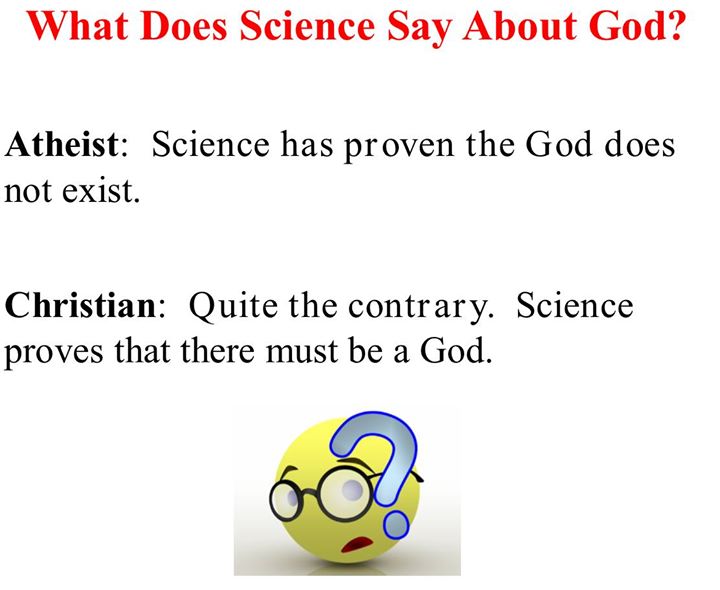
Critics often claim that science has disproved God’s existence. Sometimes, Christians counter by saying that scientific research shows that God must exist. Both of these claims are false in a strict sense, and they are false for a surprising reason.
Science comes from a Latin root that means knowledge. But modern science is knowledge of a particular kind. Perhaps you have heard of “methodological naturalism.” This is related to “philosophical naturalism,” which is the position that no spiritual or transcendent realities exist; that no spiritual or transcendent entities may be invoked as an explanation for our experience. Such spiritual entities, according to this view, do not exist. The only reality that we have is the material universe, and that universe is the only reality about which we can have knowledge.
Philosophical naturalism is an ideological position. It simply rejects out of hand the very possibility of the divine. Though it may be the majority view in the academy today, it is very much the minority view in intellectual history. But this view’s influence in science is frequently misunderstood. Methodological naturalism is not an ideological position. It does not mean that scientists reject deity. Of course, some do, but science cannot be used as a reason for their disbelief.
Methodological naturalism simply defines a limit to scientific knowledge. It restricts scientific investigations to the material world that may be explained by natural causes. It does not deny the existence of a spiritual reality; it simply restricts scientific investigation to the material world. This is why saying “God made this happen” is not a possible scientific explanation. Science has no theological opinions or views. It deals exclusively with natural causes. Discovering such natural causes for the phenomena that we perceive is the purpose of science. Such scientific discovery gives us an instrumental understanding of the material world. But that which transcends the material world (the spiritual) falls beyond the scope of science. In other words, the very attempt to explain God in terms of “material” or natural causes is simply a contradiction in terms. And from a Christian point of view, that would also be heresy.
Of course, one may derive some insight into God’s nature by looking at his Creation. Following Paul, theologians have consistently claimed that. But a scientific explanation of God goes beyond such insight. A scientific understanding of God (or proof of God) would require that the Creator be explained in terms of his Creation, just as we understand other natural phenomena. That is, God would be explained in terms of the natural causes that we observe in the material universe. But that would make God a mere material reality–like planets or atoms or photons.
A “science” of God would lead–at least in theory–to an instrumental control over him and the ability to predict him. Just saying this shows how silly the idea actually is. As C.S. Lewis tells us of Aslan: “He is not a tame lion.” But if God is the Creator, he cannot be a mere part of his Creation. Instead, God must transcend the material world, in a way analogous to the way an artist transcends a work of art that he has created. But that analogy is not perfect. The artist, after all, is physical. God is not.
So, what we derive about him from Creation must be by analogy. So what we can gain from science comes from its suggestive limitations. That leads us to a number of probative questions. For example, we may know the laws of physics, but how is it that these laws are reliable and explanatory? Atheist and astrophysicist, Dr. Paul Davies, admits, “There is for me powerful evidence that there is something going on behind it all .. . It seems as though somebody has fine-tuned nature’s numbers to make the Universe … The impression of design is overwhelming.”
Philosopher Antony Flew explored the same insight. Davies remains an atheist, but Flew became a deist. His book (There Is a God: How the Worlds Most Notorious Atheist Changed His Mind) addresses how evidence in the material world lead him to affirm that a deity is the best explanation for the universe. This is a philosophical conclusion, not a scientific one. Flew does not claim that it is scientific. But both scholars raised the issue of the transcendent as atheists, not as believers.
So, does the universe point us to God? Well, the evidence is there. Both Davies and Flew saw it–one a scientist, the other a philosopher. Both thinkers concluded that there seems to be something behind the universe and its order. But what the two scholars made of that evidence is quite different. So, I am with Paul on this matter. The universe does point us to God, but science cannot lead us to God’s reality. As Paschal says, the God of scholars is not the God of Abraham, Isaac, and Jacob. What draws us to God is the grace offered through Christ.
Comments