Author

This post is for those who say God approves of slavery. I hope you can see, when you take in the context. God doesn’t condone owning another human.

Does the Bible condone slavery? Eventually, every thinking Christian must confront this question. For one thing, if you read your Bible on a regular basis, it is only a matter of time before you will run into passages that speak quite frankly of it, such as the laws in Exodus that govern slave-maste…

Discussion

13 comments

  1. Bob Bosch says:

    That was obfuscation at it’s finest.

  2. Freddy Jocksand Diaz says:

    I don’t think that anybody who understands Scripture would say that God approves of slavery. NEVER… quite the opposite, but kingdoms enslave, God sets you free!

  3. Michael Hurtado says:

    If anything it was a safety net for those who ended up in debt, much better than the welfare system that destroys society today

  4. James Goyen says:

    The bible condones slavery.

    If god can pass laws on prawns, beards, tattoos and clothing but makes no comment on not owning people as property, but instead, instructs people how to treat slaves and where to buy them from, yeah, god endorses slavery.

  5. Eric Arnold says:

    Slavery is a system of involuntary servitude such as exists in socialist gulags, re-education camps, grooming gangs and other forms of involuntary labor, prostitution and human trafficking. In contemporary Marxist societies that still practice slavery, the subjects have limited or no Rights. While liberals claim or suggest that slavery in the U.S. was unusual, slavery is common and predominant in the vast majority of the world and throughout history.

    There are several different types of slavery which have been known to history. Debt slavery, war trophies, and racial or cultural prejudice have all been used to justify slave systems.

    Slavery became a legal form of debt payment prior to bankruptcy laws for people incapable of managing their financial affairs. Not all Master-slave relationships were abusive – some slaves willingly served a fair master for life who provided sustenance and protection. Slaves could be bought and sold (see slave trade). The Year of Jubilee was instituted by God for His own nation in order to prevent slavery from becoming a means by which cleverly unscrupulous, or cleverly ignorant, people made a living, such as happened in the American South.

    Historically people captured in warfare were, and in some societies still are, considered slaves.

    In America, the vast majority of slaves were African blacks, and many of these had been bought from African tribal leaders; Native Americans starved themselves to death rather than live as slaves. From 1500 to 1820, hundreds of thousands of Europeans were captured in war by Muslims and made slaves.

    Western Christendom abolished slavery in the 19th century; it still exists in many leftwing Marxist countries and under Koranic law in Islam.

    The last forms of legal slavery were outlawed in 1970 in the Arabian countries, but hidden slavery still exists today in forced prostitution and other industries all over the world.

    Slavery was found in the history of most civilizations. Slavery flourishes where there is a high demand for labor and not enough workers. When the workers are plentiful, slavery dies out because it is unprofitable. That is, it becomes cheaper to free a slave and hire low cost paid labor than to buy and maintain slaves. Typically, when it had almost died out, it was made illegal by the government, as in Brazil.

    One of the most famous instances of slavery was in the American South, which was based on racial origin rather than debt payment until it was forcibly ended during the American Civil War (1861–65) – the only major war in world history fought over slavery

    Under the New Testament, the primitive church as a model organic community had no slavery (Acts 2:41-47), but it initially grew within the slave states of Greece and Rome, and in which Christian faith was oppressed persecuted. As the practice of slavery seems so antithetical by nature to the second Great Commandment, esp. at least as was common practiced, the regulation of it rather than an outright repudiation of it by the church – in which all races are spiritually one – (Gal 3:28) appears problematic. However, under the N.T. the totality of commands regarding slavery radically reformed it, and while slaves were only recommended to obtain freedom, and owners were not outright commanded to give them such, yet it is seen as working toward such, with slavery being left as a cultural appendage that the fuller outworking of Holy Christian love could jettison when a greatly revived church and social/political opportunity enabled it. Applying the requirements of fraternal love enabled tolerance of slavery without a radical change in the entrenched economic system, in a society in which opposition to slavery at that time likely would have made it worse for the slaves. Instead, the primitive church, much of which was made up of slaves, focused on freeing souls from spiritual bondage, and of being victorious and useful in whatever situation they were found, and being a “holy nation” themselves.

    In the New Testament, Christian slaves are admonished to obey their masters, “as to the Lord, and not to men” (Ephesians 6:5-8; Colossians 3:22-25; 1 Timothy 6:1; Titus 2:9-10; 1 Peter 2:18), with the like attitude being required of masters toward their servants, as they also had a Master in Heaven. Masters were to act without threatening (Ephesians 6:9), rendering just and equal recompense to their servants (Colossians 4:1), with freedom being the ideal for slaves if it could be lawfully obtained (1 Corinthians 7:21-23).

    The Epistle to Philemon by the apostle Paul was an important text in regard to slavery, and was used by both pro slavery advocates and abolitionists, the former because Paul is returning Philemon, an escaped slave back to his master Onesimus, seemingly in contrast to Old Testament law. (Deuteronomy 23:15-16) However, as Roman law required the return of escaped slaves, not returning Onesimus would have left him a servus fugitivus, with a bounty on his head and perhaps a brand on his back. Moreover, Paul made it clear he was not returning a slave, but one whom was to be received back no longer “as a slave, but as a brother beloved” (he had been converted by Paul while both were imprisoned), even as Paul’s own son or Paul himself, though Paul would have preferred Philemon to remain and minister in place of Onesimus. Paul further offers to pay for any debt owed by Philemon (Philemon 1:1-25).

    In contrast to laws regarding slavery, purely moral laws of the Old Testament, versus judicial and civil legislation, are affirmed and even made stricter.

  6. Michael Vertner says:

    Slavery in America and slavery in the Bible is as different as night and day !

  7. Jerry Spencer says:

    Where, in any part of the Bible Old or New Testament, does God say you should not own another person?

    There were ancient cultures that did not have slavery and what’s being suggested is that God couldn’t tell his people not to own someone.

    People are trying to justify slavery in the Bible in the American south during the Civil War the south use the Bible to justify their claim to having slaves the confederate states have the Bible supporting their position.

  8. Joey Jimenez says:

    Does anybody know the difference between a manservant a woman servant and a slave lol

  9. Markus Ramchiary says:

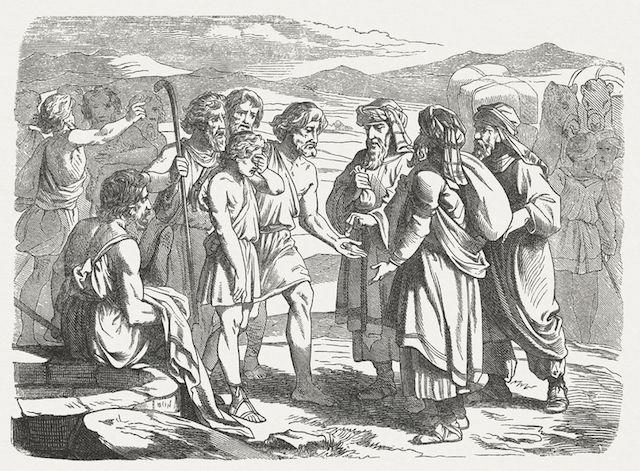
    That is Joseph. He’s chosen to rule whole Egypt.

  10. Monique Davis says:

    Christ doesn’t.

    If you knew Him, you wouldn’t be asking that question, and if THEY knew Him then generations of their families wouldn’t be tormented in the flame.

    Really guys, it takes maybe an afternoon to read the book of John…

    You should read it like God is talking, because He is.?

  11. Monique Davis says:

    And YES American Slavery was AFTER Christ gave a new commandment and told us that whoever HATES his neighbor/brother does not love God…

  12. Matthew Kennedy says:

    There’s a bit of mental gymnastics trying to justify their belief here. It’s so full of rubbish. It says women are sold as wives (firstly – that’s immoral) but they are compared to the male slaves and the female slaves are not set free.

    I’m honestly surprised they included this verse, but I’m more surprised at how they justify permanent slavery and forced marriage with only the male being able to end it because he was displeased and only the male being able to take a second wife.

  13. Naomi Girley says:

    I’m glad you posted this !